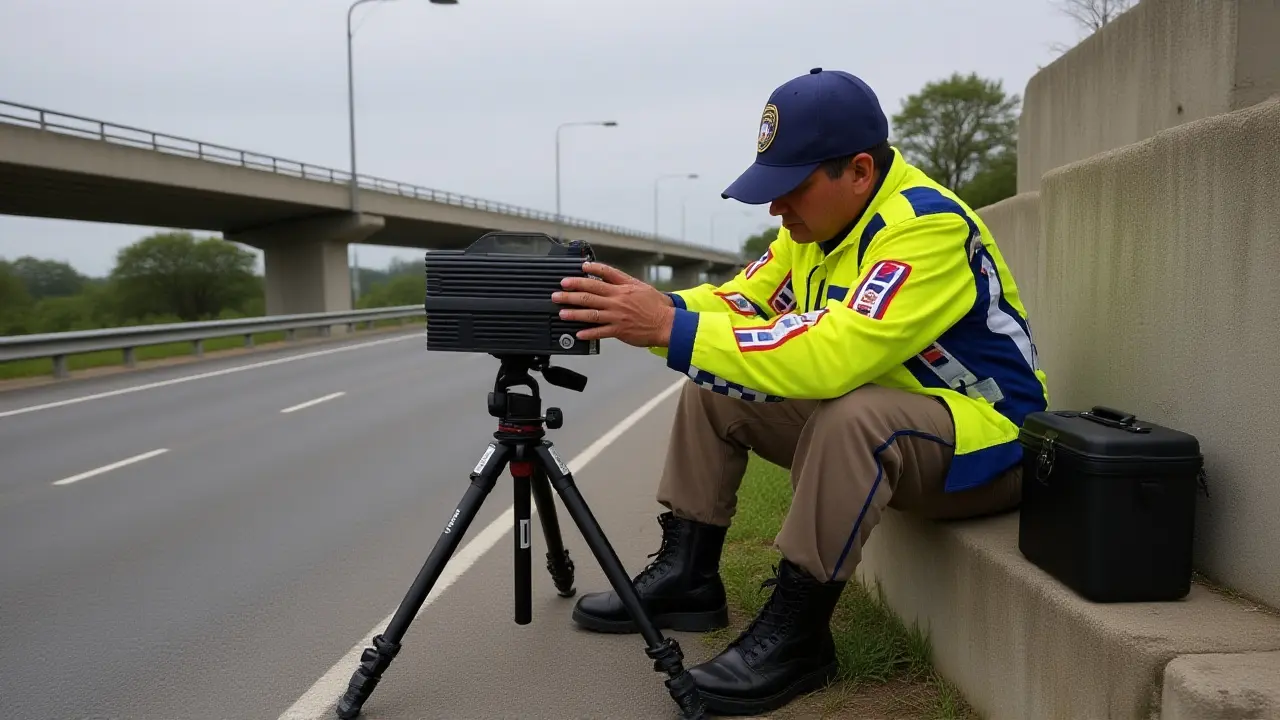
It starts with a flash of light in your rearview mirror, followed by the quiet dread of pulling over. For millions of drivers worldwide, that moment determines whether you're paying a few hundred dollars or facing financial ruin. According to recent comparative analyses, geography dictates consequence. The world's most expensive places to be caught speeding are concentrated heavily in Northern Europe. If you value speed, Norway ranks as the most costly nation globally, where even the "lightest" freeway fine hits $790.
But wait, there's more than just cash on the line. While monetary penalties grab headlines, the actual risk involves losing your license entirely—or worse, your freedom. Here's the thing: some legal systems view speeding not as a mistake, but as a moral failing worth prison time. Turnouts like Switzerland and Denmark enforce policies that ensure a speeding ticket isn't just a slap on the wrist.
The High Cost of Exceeding Limits
When you look past the borders of Western Europe, the price tag jumps dramatically. In Iceland, pushing the limit by just 21 kilometers per hour costs $750, placing it second only to Norway. Estonia follows closely at $626 for the same violation. These figures aren't arbitrary; they reflect a regional consensus that road safety demands strict deterrence. Even in the United Kingdom, where drivers often expect moderate penalties, the cost sits at $595. That's nearly double what an American driver might pay on average.
Compare that to the United States, where the average ticket lands around $150 regardless of the state. In Tennessee, fines remain lenient, while Virginia leans stricter. But in Australia, which ranks sixth globally, the averages hover around $401. State matters significantly here, too. South Australia charges $771 for a 21 km/h overrun, whereas Tasmania offers the cheapest relief at $163. It creates a patchwork reality where a driver crossing a state border might instantly face triple the penalty risk.
Switzerland's Income-Based Justice System
Switzerland stands apart for imposing some of the costliest penalties, driven by a unique approach called the "day-fine system." Under Swiss law, penalties are directly linked to an offender's income and wealth. Courts assess both the seriousness of the offense and the individual's daily earnings. The goal is to make the fine equally painful for rich and poor alike.
This structure leads to startling extremes. Because there is no maximum fine limit, the country holds the record for the world's biggest speeding fine. A multimillionaire caught driving 140 kilometers per hour in a 100 km/h zone was fined nearly 300,000 euros. That's a life-changing sum. Interestingly, even those with modest incomes face substantial penalties. The minimum penalty for the worst offenses starts at a base daily fine of 30 Swiss francs. Multiplied by 120 days, that results in a minimum bill of roughly 3,330 euros. It's designed to hurt, effectively.
Licensing and Imprisonment Risks
Money isn't the only stake. In Denmark, ranked fourth among the worst places to get caught, the law mandates unconditional license withdrawal. Whether you're speeding in a residential area or on a freeway, your license goes away. The suspension can last anywhere from 6 months to 10 years. If you exceed the speed limit by 13 miles per hour in a residential zone, the fine is $673. Go 25 miles per hour over, and you're looking at $968.
Then there's the threat of jail. France and Monaco rank third for enforcement severity. Both allow imprisonment for repeat speeding violations. It's rare to hear about people going to prison for traffic tickets, but the statutes exist. In Switzerland, speeds exceeding 24 miles per hour over the limit can result in imprisonment for a minimum of 1 year. For severe cases, the roads simply become off-limits permanently due to license confiscation lasting months.
Global Variations and Recent Updates
Beyond the heavy hitters, other regions are tightening up. In England and Wales, regulations changed effective April 24 to increase penalties significantly. A driver doing 101 miles per hour on a motorway could now face a fine up to 150 percent of their weekly income, raised from the previous 100 percent. There is still an upper limit of £2,500, but the shift targets higher earners specifically. Belgium also records extremely high numbers of violations, documenting 7.6 million speeding offenses out of 9.2 million total traffic violations in 2024.
Meanwhile, mobile phone usage introduces a different tier of danger—and cost. Canada is the most expensive country globally for using a phone behind the wheel at $378. For running a red light, Greece takes the top spot at $1,094, beating Norway's $1,091. The landscape varies wildly: Poland allows 140 km/h legally, while Malta caps it at 80 km/h, making it one of the strictest zones in Europe. Drivers must always respect local signage, because the rules don't translate across borders.
Frequently Asked Questions
Why are speeding fines higher in Northern Europe?
Governments in countries like Norway and Iceland prioritize road safety above convenience. Higher fines act as a stronger deterrent, encouraging drivers to adhere strictly to posted limits. Additionally, these regions often fund public infrastructure through these penalties, creating a cycle where enforcement remains rigorous year-round.
Can you go to jail for speeding in Switzerland?
Yes, imprisonment is possible for extreme cases. If a driver exceeds the limit by more than 24 miles per hour, they may face a prison term of at least 1 year. The country utilizes a day-fine system that scales with income, but severe negligence triggers criminal charges rather than just civil fines.
What happens to your license in Denmark?
Danish law states that exceeding the speed limit results in unconditional license withdrawal. The suspension period ranges from 6 months to 10 years depending on how much you exceeded the limit. This makes Denmark particularly dangerous for expatriates or tourists unfamiliar with the strict zero-tolerance policy.
Are fines adjusted based on income?
In Switzerland, yes. The penalty is calculated using a "day-fine system" based on daily earnings, ensuring wealthy offenders pay proportionally more. In the UK, recent updates allow fines up to 150 percent of weekly income, though there is a capped maximum limit of £2,500 for motorway offenses.
How do US fines compare internationally?
The US average sits at roughly $150, which is significantly lower than European standards. However, this varies by state; Virginia and Illinois enforce stricter penalties compared to Tennessee. Unlike the UK or Switzerland, the US generally uses fixed fees rather than income-based calculations.
18 Comments
I just want to remind everyone to always check local speed limits before crossing borders. It can save you so much stress in the long run. Nobody wants to deal with that kind of financial surprise while traveling. Safety really should be the main priority for all of us on the road.
It is absolutely imperitive that citizens respect the law!!!!! You cannot simply ignore regulations because you feel entitled to speed. The moral failing of speeding is clear and evident in these statistics!!! Punishment must be swift and severe to deter bad behavior!!! Lawlessness is what allows dangerous conditions to persist on our highways.
Reading through this really sheds light on how different cultures handle traffic safety. It is fascinating to observe the disparity between regions. Some nations clearly value order above individual freedom. Others seem to prioritize mobility and lower costs instead. The economic burden placed on wealthy citizens in Switzerland is quite telling. They effectively remove the option of paying a trivial amount to get away with it. This ensures that everyone feels the sting equally regardless of bank balance. Of course, losing a license creates immense hardship for anyone who relies on driving. Public transport networks in those countries are fortunately quite developed though. Here in the states we rarely face such draconian consequences for simple speeding. Our approach focuses more on monetary punishment than physical restriction. Perhaps we should learn from the effectiveness of stricter deterrent measures globally. Safety records suggest that fear of consequence works better than cash alone. People tend to slow down when they know jail time is a possibility. Ultimately these policies aim to preserve lives rather than punish for profit. It forces us to consider the true value of following basic rules consistently.
Did you ever stop to think that these fines are just a way to fund government projects quietly? They set the prices high to drain the economy of drivers. It feels like a hidden tax that nobody wants to discuss openly. The prison threat is likely just a scare tactic to keep compliance up. We need to question who benefits from these expensive penalties in the long term.
People need to realize that American drivers know better than anyone else how to manage speed. European systems are trying to restrict our freedom unnecessarily. We pay for our own insurance and handle our own risks here. Their fines are excessive and designed to exploit tourists specifically. Why should we worry about their rules if we stay home?
Pathetic reasoning. 😠
Honestly the day-fine system sounds like a great way to separate the rich from the poor. Imagine paying three hundred thousand euros for going ten miles too fast. It basically guarantees that only the poorest can afford to drive safely there. The irony is truly delicious when you think about it.
I totally agrue that teh rich shoulld pay more bcuz it feels fairrrrr. But somtimess teher are typos in my typing becaus i am rushd. Speedin limits r weird thoo. I hope evryone drives safe and aviods the ticket. It saves mooney in the long run for surrre.
USA is still the best place to drive honestly. We dont need jail for a little extra speed. Other countries are just overly dramatic about rules. 🇺🇸 We handle it our own way without needing strict foreign laws to tell us what to do. Freedom of the road is something we cherish deeply.
Freedom is nice until you crash into someone.
Yeah the numbers definitely back that up. Its wild how much more expensive it is over there. Probably better just to leave the car at home if you go visit Switzerland. No one wants that headache.
The jurisprudential framework governing these offenses varies significantly across jurisdictions. The mitigation of risk through financial penance is theoretically sound yet practically flawed in certain contexts. Enforcers must utilize discretion within the statutory guidelines to ensure equitable outcomes for all motorists.
I traveled to Norway last year and the roads were incredibly well maintained. Everyone respects the speed limit there for sure. Renting a car was scary because of the potential costs involved. But the scenery was worth the anxiety about the police radar guns.
I went too and the radars everywhere. It is verry stricktt therre. Yuo shuld lissen to the signs. Dnot drive to fassst. It is dengerous on thoe roods.
In India we have different challenges with overcrowding on the roads. Speed limits are often ignored by everyone sadly. These European models are interesting for safety improvement discussions. Hopefully our administration adopts stricter protocols eventually for better order.
Your perspective provides valuable insight into global variance. It is essential to recognize that safety standards differ across geographical boundaries. One must approach international travel with caution and adherence to local statutes.
The asphalt ribbons stretch endlessly under the gray skies of Scandinavia. Drivers glide upon these glistening paths with a trepidation unique to northern climes. A single flash of red light halts the journey abruptly. The metallic taste of fear fills the air swiftly. Wallets bleed currency like open wounds in these penal colonies. Roads become silent corridors of enforced obedience.
The regulatory landscape regarding vehicular motion presents numerous complexities that require careful examination. Financial deterrents are merely one facet of a broader spectrum of legal ramifications. Compliance should be viewed as a civic duty rather than a burdensome obligation imposed by authorities. Long-term societal benefits accrue from consistent enforcement of traffic norms throughout the region. It is crucial to maintain these standards for the collective good.